Showing posts with label art. Show all posts

Friday, 10 August 2012

India at altitude

Once again I've been very tardy about posting following a jaunt out of Delhi, for which apologies. Anyway, about a month back I hopped on a flight up to Leh, in Ladakh up in the high Himalaya. This is a corner of India quite unlike any other - it really does feel like you've stepped into another country. The culture, the scenery, the people are all decidedly closer to Tibet (which I was lucky enough to visit a decade or so ago) than they are to the Ganges plains. Leh itself doesn't really feel like an Indian town (apart from the incessantly honking horns - I'm not sure there's anywhere in India, apart from maybe the smaller islands in Lakshadweep or the Nicobars, that doesn't feature that). The usual hustle and bustle, the overwhelming activity that you seem to find pretty much everywhere else, is absent. In its place is a laid-back, relaxed atmosphere quite at odds with the fact that the place is in Jammu and Kashmir state - one of the most unstable trouble spots in the world - and hosts a huge military presence.

My time in Ladakh was all too brief - just four days, which was just enough time to adjust to the altitude, do a little bit of trekking, see some fascinating monasteries and buy a rather nifty rug. My friends Nick and Alex, who are travelling round India for a few months, had rather more time to appreciate it. But it was a wonderful place to escape the heat and the crowds of Delhi for a little bit, and kicking back with a cup of chai and watching the sun set over the mountains from a cafe seemingly squeezed into someone's attic was heavenly. Less heavenly was our trip back to Leh after the trek, which involved an ill-advised attempt by our guide to ford a stream in our little minivan. It took a couple of hours to rescue the minivan, and we had to get the army involved. Fun!

So here are some photos from the trip. I hope you enjoy them.

Minaret in Leh. The dominant culture may be Buddhist but the city has seen significant immigration, and now hosts quiet a diverse population including a significant number of Muslims. I did think this was a particularly graceful piece of architecture.

Looking up from Leh's old town towards the palace, perched on a ridge above the city.

Typical view in Leh

The marketplace at Leh. This is pretty much about as busy as it got while I was there - this would be the slowest of slow days in Delhi.

New hat. Ahem.

The Red Temple, high above Leh. Getting there was a struggle but worth it.

View between the prayer flags from outside the entrance to the Red Temple. I was really quite pleased with this photo!

Nick And Alex outside the red temple

And Alex and me! As you can see my legs have entirely failed to notice that they are exposed to the sun.

Nick and Alex horsing around. Leh in the background.

Typical view of the valleys in Ladakh. It's amazing how the barren mountains give way to the lush green valley floor, which looks like a carpet or even the surface of a lake. The Ladakh irrigation systems must be superb - literally nothing grows beyond the confines of the valley.

Prayer flags tethered to an outcrop, Red Temple, Leh

This is the confluence of the Indus and Zanskar rivers. The scenery in Ladakh is majestic: all sweeping panoramas of mountains in various shades of brown and grey, punctuated by pockets of green, and sitting underneath skies that seem almost unnaturally blue. I have to admit though that after a while in the mountains I did start to miss the greener environs of lower altitudes!

One of the few photos I took inside one of the monasteries we visited. We were told that photos were fine, but I still felt very uncomfortable taking them. Just to my right there were about 100 monks chanting in prayer, and I felt like a coarse and vulgar intruder. I took this one shot and then stopped. 

I love that the temples and towns of Ladakh make up for the lack of colour in the environment by making everything they can colourful.

Monks at Lamayuru monastery. 

Yup, it's a seriously big Buddha.

I'm not sure what the significance of the headgear or the percussion is (if anyone can enlighten me I'd love to know). But taken together they certainly create an impression.

There was a large pile of firewood stacked up outside the monastery - I guess they get supplies in during the summer for the long and hard winter.

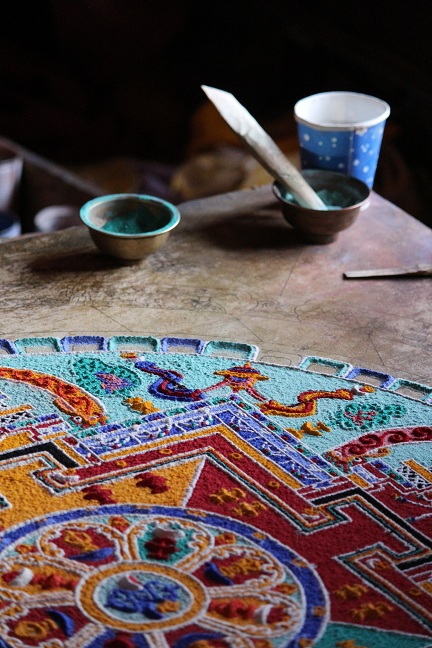
This was possibly the highlight of the trip - at Lamayuru monastery we came across a group of monks creating a mandala out of coloured sand. It's a painstaking process but they had achieved this in less than 24 hours. Temple was filled with the sound of them scraping their metal tools together to deposit tiny amounts of sand in the exact right position to create the intricate and beautiful pattern, chatting quietly as they did so. Outside the mountains were bathed in bright sunshine and birds flitted around the windows. It was a world quite apart from anything I've ever experienced, and it was breathtaking.

Close up of the tools used to create the mandala.

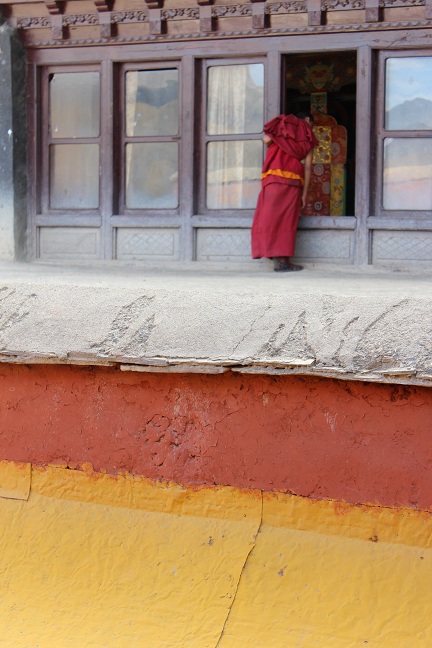
I like this picture because it tricks the eye. He is actually standing on a broad, flat roof (the white part) but it looks like he's perched on a narrow ledge. 

Young monk taking a rest from work


I like the combination of banality and grandeur in this photo.

Life is hard in Leh. I spotted this lady coming with her heavy burden as I was gazing out from the monastery wall. It's sometimes easy to focus on the picturesque monasteries, monks and prayer flags and forget that people have to earn a living up here in the barren mountains.

Wood stacked up in Lamayuru village. I liked that it was so neatly arranged by type of wood - I presume each has different properties, so they need to be kept separate. But it also created a textural contrast that I thought was really beautiful.

The village at Lamayuru.

Looking back towards Lamayuru after setting out on our short trek.

Three sweaty people.

Early attempts to rescue the minivan after the afore-mentioned incident in the stream. Needless to say pushing the thing was never going to work. Ultimately we had to flag down an army truck, then find a length of chain, and then have about eight people pushing before we could get the thing out of the water. I got to push, and felt all butch. For a second.

All this is just a couple of hours' flight from Delhi, and it feels like another world. It's a cliche to say India is astonishingly diverse, but - well - it is. 

Saturday, 17 December 2011

Entertaining Madam President

Last night I participated in one of the most unusual carol concerts I've ever attended - certainly one of the most memorable. It took place in the ballroom of the Rashrapati Bhawan - the Presidential Palace - with the President of India, Pratibha Patil, in attendance. The carol concert takes place every year with several choirs from across the country invited to take part, and this year (for the second time) the choir I have recently joined, Capital City Minstrels, was included in the programme. Needless to say, I was quite excited at the opportunity to sing for a Head of State!

The palace itself was built towards the tail end of the British colonial period as the residence for the Viceroy of India, and became the President's residence on India's independence. I'm not particularly inspired by the exterior - or indeed by the rest of Lutyens' Delhi, as I've blogged before - which manages to combine squatness and pomposity (though, as a fellow chorister pointed out, it's still better than Buckingham Palace):


Sadly we weren't allowed to take cameras inside, so you'll just have to take my word for it when I say that the interior is much more pleasing. Of course it's all terribly grand, but somehow the proportions seem to work far better once you're inside, and the marriage of classical architecture with strong Indian influences is really stunning. The effect is only slightly marred by the red masking tape marking the edge of all the stairs (the original designers apparently having failed to realise that two white marble steps in the middle of a long white marble corridor is a recipe for unfortunate mishaps).

The ballroom itself, though, is quite simply one of the most gorgeous rooms I've ever been in. Mostly this is due to the paintings that cover the walls and ceiling, featuring scenes reminiscent of the best Mughal miniatures (though magnified rather a lot, obviously) surrounded by lovely arabesque floral designs. I spent quite a lot of the concert (when not singing) with my head back feasting on the beauty of it all. I felt enormously privileged to be able to do so.

Preparations for the concert were extensive - we arrived at 3 and didn't start singing until half past five - and organised by the Indian military (I presume the Presidential guard) with a technique that showed a great deal of respect for tight timing and absolutely no recognition of the practical matters of getting entire choirs on and off a stage. As a result we over-ran by nearly an hour, but good humour seemed to prevail.

Apart from our three numbers we had a mixed programme, including a couple of children's choirs (actually not bad) and a really amazing performance by a group called Voices of Hope, from Nagaland on the border with Myanmar, whose conductor Nise also plays piano for our choir and who has a heartbreakingly beautiful singing voice. There was also a group called the Delhi Syro-Malabar Mission, who sang a number in the Malayalam language from Kerala which, upbeat and highly enjoyable though it was, is, I fear, unlikely to be joining Silent Night and Jingle Bells on the list of Christmas classics any time soon:


Apparently, that little mouthful translates roughly as "Do re mi fa so la ti do...the holy light over the stable". Doesn't really trip off the tongue in either language.

Once the choirs were finished we had a Christmas message from the Cardinal of Ranchi, who rejoices in the superb name of Telesphore P Toppo. No, really. It's an even better name than Cardinal Sin. The evening was then slightly marred by the appearance of two very skinny santas wearing frankly terrifying masks, which of course put me immediately in mind of a certain episode of Dr Who and made me fear for the safety of everyone present:


Baffling, this. As a fellow singer pointed out, India hardly has a shortage of rotund gentlemen with white beards. The preference for skinny guys in hideous masks is something I can't really fathom.

To round off the evening we had a good old singalong, including the following verse of Jingle Bells. I can honestly say I have never heard this verse before, so I'm wondering if any of you have ever come across it. And what is the meaning of the word "upsot"? Answers on a postcard...


And the President? Well, she sat dutifully through it all, perched in splendid isolation immediately in front of the stage in a white armchair that seemed far too large (she is a tiny but dignified elderly lady). At the end she congratulated all the conductors and then posed for photos with all the choirs (I will post ours on here as and when it's sent). At one point one of the choirs sent up two of their members for a photo dressed as Mary and Joseph, at which point the President grabbed the Baby Jesus out of Mary's arms for an impromptu shot, which I thought was a nice touch. But it's rather hard to say how much she enjoyed it all. The presidential role here is largely ceremonial so I imagine she has to go to a lot of this kind of thing, and she maintained a fairly inscrutable expression. But it was an honour to perform for her, whatever her thoughts on the matter!

Altogether a truly memorable evening and one that reflects India's embracing of its many different cultures and creeds as well as its love of festival. Despite the rigid security, the inevitable formality of the event, and the fact that a majority of the people present were not Christian either by background or by belief, it was one of the most enjoyable Christmas events I've been to. And just the fact that it happens at all - hosted by the President of a country that is only about 2% Christian - is really quite beautiful. I feel lucky to have been there.

Saturday, 23 July 2011

National museum artefacts 5: a guest appearance

Haven't done one of these in a while, but I still have a good few things worthy of comment (and am planning a return trip to the museum before too long!).

Anyway, one of the joys of the museum is its section on Indian miniature paintings. They're fascinating portraits of life in a vanished society - the court of the Mughal rulers of Delhi who preceded the arrival of the British. They are particularly interesting because the Mughals were Muslim, but their art features some of the loveliest renditions of the human form you are ever likely to see - not normally something associated with Islamic art (they were also responsible for some of the most beautiful architecture in the world, including the Taj Mahal). The paintings don't really lend themselves to casual photographing, but you can see some lovely examples here.

One of the examples listed there really intrigued me, and it was this one:


At first sight the main thing you notice is the beautiful gold leaf script and decoration surrounding the central portrait, which represents one of the Mughal emperors, Jahangir (1605-27). The portrait itself is revealing: you might expect an early 17th century emperor of Persian and Mongolian stock to be depicted as a warrior, but what we see is a sensitive and artistic-looking young man - clearly someone who valued culture above conquest (despite this, he apparently enlarged the empire significantly during his tenure as top banana). But when you go for a closer look at Jahangir you notice that what he is holding is a bit unexpected:

She gets everywhere, doesn't she?

Yep, it's the virgin Mary, in the familiar meek-and-holy posture in which she is depicted in churches across the Christian world. But what's she doing in a portrait of an Islamic ruler, far distant from the nearest centre of Christianity?

Turns out we have a Brit to thank for this, though one who shared his culture with India in a rather less brutal way than his successors. Thomas Roe came to Jahangir's court as ambassador for King James I in 1615, bringing with him several paintings with Christian themes. Clearly they caught Jahangir's eye to the extent that he commissioned the above portrait.

This fascinates me for what it says about the culture of the court in Delhi at the time. In England, we'd recently had Elizabeth's persecution of Catholics (and Queen Mary's persecution of protestants before that), and we still had jolly old Olly Cromwell, that paragon of religious tolerance, to come. But in Islamic Delhi, the emperor was having himself painted with an icon of a foreign religion (actually, interesting question: I know Jesus is recognised as a prophet by Islam, but anyone know what it has to say about Mary?).

Of course the Mughals also pulled off the rather unusual feat of ruling for centuries over an empire that was overwhelmingly of a different religion to them, apparently without serious efforts to covert their subjects (though they had wars aplenty with neighbouring Hindu dynasties). The contrast with the ruthless efforts to suppress dissenting religious views in England (and elsewhere in Europe) at the time is striking, and shows just how recent an arrival tolerance is to our now-cosmopolitan society.


Sunday, 17 July 2011

The unbearable loveliness of things

I'm not normally the most materialistic of people, but today I made the mistake of wandering into an art and furniture shop in Hauz Khas village, a lovely little enclave in South Delhi built around the ruins of a 14th century Madrassa (theological college) and surrounded by a huge deer park. Oh, such a mistake. If there's one thing that India knows how to do, it's make objects of such loveliness that one's wallet practically leaps out of one's pocket of its own accord.

The thing is, I currently live in a rather large and very empty apartment. When I look at that exquisitely carved and painted wooden seat for somewhat less than the price you'd pay for one of IKEA's less nice sofas, I actually have a spot where it would work. That huge, beautifully painted panel? I have the wall spot for it. That delicately enamelled screen? Perfect to separate off my dining space. You would not believe the sheer number of lovely things and the number of arguments I had to have with myself to stop me buying them. There was even a swinging wooden double seat, complete with wooden frame carved in the form of various animals, that would fit beautifully in my living room. But, of course, it and all the other lovely, lovely things were entirely impractical.

Because the big empty apartment is a mirage. Anything I buy here would need to be shipped back to the UK, probably costing about as much as I paid for it. And of course, back in London I don't have a great big empty apartment. I have a tiny (but much-loved) flat that is already pretty much stuffed to the gills with furniture. So I am going to have to do a lot of resisting for the next couple of years.

But oh, lord, there were some lovely things. And my apartment really is very bare...

Thursday, 14 July 2011

National museum artefacts 4: Flummoxed

I'm feeling a bit lazy and unimaginative tonight (still in that weather-induced funk I blogged about yesterday) so it's another trip to the national museum I'm afraid. Tell me if these are boring you. However this one really is intriguing.


OK, so the information for this one explains that it is "King Narsimha worshiping Jagannatha", and that it dates from the 13th century in Orissa (on the east coast of India). Fine, you think. I guess that's the king on the right, and some sort of divine flunky in the middle who's lost his head. And on the left...

Well, yes, on the left. What's on the left? There are a couple of thrones, on one of which sits a female figure, and on the other one, well, let's have a look:


And a bit of a closer one:


My thought at this point was: What the hell is that? My best explanation was that at some point, SpongeBob Square Pants traveled back in time to 13th century Orissa and was immortalised as a god by local artist.

I've since looked the god up on Wikipedia, and apparently this is just what he looks like. In his most famous temple at Puri, Jagannatha "has a massive square head with the chest merging into one piece of wooden stump without any demarcation of the neck. The arms have been inserted in a line with the upper lip." In other words, Jagannatha is a god who looks like an ice cream cone with a face.

Against the better known pantheon of India's gods, all gorgeous figures with multiple limbs in lithe dancing postures, this definitely seems like a bit of an oddity - and without wishing to be disrespectful, a little bit comic. But then, when you've got this many gods, I guess some are bound to turn out a little bit unconventional.

Wednesday, 13 July 2011

National museum artefacts 3: Buffalo on a skateboard

I'm a BUFFALO! On a SKATEBOARD! Yeah!

Well, that just seems to me to be the kind of thing a buffalo on a skateboard would say.

Sunday, 10 July 2011

National Museum artefacts 2: frankly disturbing

I mean, this was probably disturbing enough before it lost its limbs. But....yikes.


National Museum artefacts 1: the oversized chair

It's raining today. Not just a monsoon flash-in-a-pan downpour, but a steady stream that's English in is constancy and Indian in its heaviness. Outside my window the street is already flooded (note to Sheila Dikshit: now that the Metro is such a success, how about focusing on the city's drainage system?).

So I think I will be staying home today. Happily, as I mentioned in my last post, I've stored up plenty of things to blog about, not least the brilliant National Museum, which, displaying though it does but a tiny fraction of the country's artistic and cultural heritage (and short though it is on explanatory displays) is one of the most fascinating museums I've been to in a while.

Originally I was going to snap some of the more interesting exhibits and put them all in a single post, but I got quite carried away and took photos of well over a dozen. So I'm going to drip feed them into the blog in a series of short posts which will make me look like a seriously prolific blogger. I hope you find this vaguely interesting!

Most of the museum's prize exhibits are on the ground floor, but I'm going to start with something that is tucked away on the top floor. It grabbed me from the moment I saw it and still fascinates me with questions. It was in a section ambiguously entitled "ethnic art", which I think means it comes from one of the tribal areas in Central-Eastern India. But there was absolutely no information to accompany it whatsoever, leaving me to conjecture about its possible origin and meaning.


When I first saw it I actually thought it was some strange kind of chariot with two people at the reins. It's made of metal and the figures perched on the edge combined with the dangling circles of metal shapes at the back and the little animal figures made me think of the Sharmanka kinetic theatre I saw recently in Glasgow (by the way, if you're ever in Glasgow do go and see that, it's really incredible).

But then I realised that if this thing were to lurch into life like Sharmanka's creations, it would be going nowhere - the figures are perched on the edge of a chair that's far too large for them (the whole thing is a little bit larger than a regular dining room chair). Why? What's the significance of what they are holding (the male figure on the right has an axe, the female on the left a basket)? Why is the male's arm lowered and the female's raised?


There are so many little details to enjoy. The little birds perched behind the couple, looking back at the viewer (you can see one just above the female figure's raised arm); the incredible decoration of the female figure's ears; the calm and somewhat complacent expression on the faces.

I kind of wish there had been some information about the piece. But at the same time it's fun to be able to use your imagination a bit about what it all means (I'm going with some kind of wedding celebration). And it's just an extraordinary thing to look at.