Showing posts with label history. Show all posts

Wednesday, 30 November 2011

Yes, you did read that right

I was in Amritsar recently (on which more to come) and couldn't help but notice that the place was plastered with posters for a movie with a title which, for European visitors, was rather eyebrow-raising:


Um, what? Let's have a closer look:


Yep, that's right. The big Punjabi movie hit of this season glories in the name Hero Hitler in Love.

Naturally I had to investigate this, so after taking the above snaps I got online to check the film out. Apparently, in the movie, "Hitler is a man with unique and different thoughts who loves his fellow villagers and helps them unite their soul mates."

So just to clarify, then, we're not talking about the most notorious psychotic mass-murdering dictator of the twentieth century. We're talking about a sweet, admirable and quirky Punjabi villager.

Called Hitler.

Anyway, apparently Hitler falls in love (the title kind of gives it away) and, although he believes in solving problems by talking about them, something happens that makes him decide to "become real Adolf Hitler".

Now, I haven't seen the movie, so I don't know if it features a Punjabi villager invading half of Europe and slaughtering millions of Jews, disabled people, gypsies and homosexuals (all in the name of love, of course). One can only presume not, which begs the question of what "becoming real Adolf Hitler" involves for Punjabi audiences.

Oh, and apparently Hitler is also an entrant in the Asian Car Racing competition. You read it here first.

I'm trying to imagine an equivalent film being released in the UK, called, oh I don't know, Pol Pot Gets His Groove Back, without uproar. I find it difficult.

I'm reminded of an incident when I was in Korea, when a Nazi-themed bar opened in Seoul, complete with swastikas and imperial German eagles, with staff all (in)appropriately dressed as SS officers and storm troopers. The resident expat community was horrified, but many Koreans simply couldn't understand what the fuss was about. It was just a fun bar with a historical theme. The idea that events that occurred in Europe sixty years ago could still resonate enough to cause deep offence came as a surprise to many, not least the bar's owners who thought they'd hit on a great marketing ploy. (Of course, this neutralisation of history would never apply to, say, the Japanese occupation of the Korean peninsula, which ended in 1945).

In the West, we are educated about Hitler and the Holocaust from a young age. He is more than a historical hate figure: he is someone whose crimes have been personalised for all of us from the first time we read about Anne Frank. He is, of course, not immune to being the object of humour. But while we may laugh at him and about him, he is rarely trivialised. We can't let ourselves forget the magnitude of his evil.

So it's unsurprising that, for me, the movie and its complacent plot description stick in the gullet. But then, of course, it's not Indian history. Hitler's name might be universally associated with evil, but the strength of that association varies a lot depending on where you are. And political correctness is probably less well established in the movie industry of Punjab than in the BBC studios or in Hollywood.

Ignorance is as ignorance does, of course. Few Brits know about the history of India, including that bit of it where we played an inglorious role. So it's hard to get very upset about a lack of sensitivity on the part of Indian film makers (or, for that matter, Korean bar owners) towards Europeans' historical hang-ups. But the Punjabis' lovestruck, heroic Hitler is another example of how, globalisation or no, the world according to Indians and Europeans looks very, very different.

Sunday, 21 August 2011

Indira's shadow

Has there ever been a world leader whose appearance demanded attention as much as Indira Gandhi's? With that shock of black-and-white, Cruella de Vil hair, unmistakable nose, and fiercely intelligent eyes, hers was a face made to be on the front page of the newspaper if ever there was one. She died nearly 27 years ago, but her impact lives on in India - and not just through the fact that her family name remains the most powerful one in the country's politics.


She was assassinated at her home in Delhi, which has now been turned into a memorial to her and to her son, Rajiv, who succeeded her as Prime Minister in 1984 and was assassinated in his turn. My visit there today was a claustrophobic affair. The site of the martyrdom - for that's what it is seen as - of the nation's favourite daughter is a place of pilgrimage for Indians, who jostle and cram their way into the somewhat cramped exhibition halls - covered with newspapers spanning the decades of her career and Gandhi family photos - and have a habit of thrusting their mobile phones in front of the display you are looking at, in order to get a snap. It didn't allow for a great deal of peaceful contemplation of Indira's impact, but it shows just how large a figure she still looms in Indians' minds.

She was certainly an extraordinary figure. As a child she had to get used to the repeated incarceration of her father, Jawaharlal Nehru, who was a leader of the Indian independence movement and became the country's first Prime Minister after the end of British rule. Her political awareness thus not only started young, it was personal right from the start - which maybe helps explain her later dictatorial tendencies. The photos and sketches of her from the time show a serious girl, with large, intense eyes that seem to hint at the remarkable life she was to lead:


She herself was imprisoned by the British - and, years later, by her political opponents in India. She served as Prime Minister for a total of fifteen years, including during Bangladesh's successful war of independence against Pakistan, in which India played a decisive role.

She was famous for her sharp political instincts, that helped her stay in power for so long, and must have cut an intimidating figure. She was fiercely committed to improving conditions for India's poor, and drove through the Green Revolution that allowed the country to feed itself. But she was also responsible for some of the darker moments of India's post-independence period, including a 21-month state of emergency (proclaimed on rather tenuous grounds) which allowed her to rule effectively by decree, and the event that would lead to her assassination, the storming of the Golden Temple in Amritsar in an effort to root out separatist Sikhs calling for the creation of an independent "Khalistan" in the Punjab.

Among Sikhs, unsurprisingly, she hardly cuts a popular figure, and she inspired unusual ire among her political opponents, as well as Richard Nixon (so she can't have been all bad). But for most Indians, she is remembered as a great national leader of a status comparable to her father. Unsurprising, then, that the memorial museum tends towards the hagiographical: the State of Emergency and the violence in Amritsar are brushed over, and no mention is made of the immediate aftermath of Indira's murder, when thousands of innocent Sikhs were killed - many burned alive - in revenge attacks across Delhi and elsewhere in India.

The museum displays her living quarters, preserved in her tasteful but rather spartan style, as well as the sari, bag and shoes she was wearing on the day she was shot by her Sikh bodyguards in revenge for the attack in Amritsar. The blood stains are clearly visible:


It might be trite to say that death is the great equalizer, but looking at this small collection, and her very ordinary bag and shoes, it's hard to associate them with one of the twentieth century's most important leaders or with an event that went on to shape - and destroy - thousands of lives. Rajiv's clothes at the time of his own murder seven years later are also on display, and have an altogether more shocking impact:


The violence of Rajiv's death - he was blown to pieces by a suicide bomber - is clear. For some reason though, it was the socks that moved me - oddly intact, just grubby, as though Rajiv had been out for a run and dumped them on the floor afterwards, and incongruous with the solemn museum setting.

Anyway, after musing on Indira's life and death, I made the ten minute walk to the spot where another Gandhi - even more famous than Indira - was also assassinated. The place where Mahatma Gandhi was killed is also preserved as a memorial, but was far less crowded than Indira's. This got me thinking about the meaning these two people - who were close personally but very different in their historical roles - have for the country today.

Others are much better qualified than me to judge, but to me the bigger crowds at Indira's memorial reflect the fact that for modern India, her shadow is longer than the Mahatma's. Mahatma Gandhi is, and always will be, an iconic figure internationally, and India continues to hold him up as a role model and one of the founding fathers of independent India. But for all that people profess to admire his ideals, few Indian public figures since then seem to follow them much.

Certainly his frugal lifestyle is not often followed by those Indians who have a choice in the matter. His condemnation of the oppression of women and of caste distinctions have not prevented them remaining widespread in India more than 60 years after his death. Even in my own area of vocational education his words sound at odds with prevailing attitudes here: Gandhi said that "instead of regarding craft and industry as different from education, I regard the former as the medium for the latter". That's not a popular view in a country where work-related education is still associated with low caste and low prestige in many circles.

I say this more in observation than condemnation, for if India had followed Gandhiism, I suspect it would be rather worse off now than it is. The pursuit of wealth may have created some very ugly inequalities, but it has also allowed for economic growth that has lifted millions out of poverty. Ultimately, Gandhi's asceticism was something he chose - because he was in a position to make that choice. Most Indians - like most people elsewhere - don't make that choice. It makes him an extraordinary person, and an admirable one, just as his approach to challenging British rule proved astonishingly effective. But it doesn't mean that his way is in any sense practical as long term public policy.

Indira, though, in her awareness of her own power, her willingness to use it and her belief - no less than Gandhi's - in the cause of India, seems to me to have more in common with the increasingly assertive and confident country India is today. That has some good consequences, and some potentially scary ones - the India-Pakistan relationship being top of the list of the latter.

Modern India, nuclear-armed, accustomed to sabre-rattling and struggling with rampant graft, seems to have a politics that owes little to peaceful, self-denying Mahatma Gandhi. In this, I guess it is little different to the rest of the world - where he is held up an admired as an inspiration, but where politics dance largely to a different tune. One that Indira knew better.

Tuesday, 16 August 2011

Old walls and old wells

I still
cannot get over the sheer number of ancient sites and monuments in Delhi. We Europeans tend to think of Asian cities as modern affairs - either squat concrete or shimmering steel-and-glass - and that Europe is where you go for truly old urban architecture. But there are few places in Europe that come close to rivaling Delhi's wealth of heritage buildings - as a few posts on this blog have attested.

My latest bit of exploration into Delhi's history is probably the most dramatic - the Purana Qila or Old Fort, which lies north of Humayun's tomb and south-east of India Gate and the Rajpath. As with Old Delhi, the "Old" bit of the name is not really accurate: this is the site of the sixth of the cities that have stood here, and was Humayun's (he of the beautiful tomb) centre of power in the sixteenth century (though it is reputedly also where the first city, Indraprastha, stood). It's also where Humayun met his end - after falling down a flight of steps, which seems a cruelly undignified way for a man of his standing to go. Its massive walls tower dramatically over this part of Delhi, and the main gate was clearly designed to impress:


There's not much that survives inside the walls though, other than Humayun's graceful little observatory and a mosque, dramatically positioned overlooking the valley of the Yamuna river and featuring some wonderful mosaic work on its facade.


From its defensive position, the Purana Qila looks down on the whole valley - although the river itself has shifted course away from its walls these days. Of course, nowadays the valley features some rather less beautiful architecture, which provides some interesting contrasts:


The once-impregnable fortress is now a favourite spot for an evening stroll for the citizens of Delhi, who come and have their photos taken outside the ancient buildings. As you can see, the occasion gives rise to unmitigated joy and gay abandon on the parts of the participants:


But if you don't fancy a walk and would rather a sit-down activity, you can always opt instead to take a boat around the slightly swampy-looking boating lake that sits at the north-west foot of the walls. It looks like a pleasant excursion, but I can't help thinking that the sight of these garishly coloured pleasure boats and giant ducks pottering about beneath the towering, defensive ramparts looks a bit incongruous. I wonder what Humayun would have thought of this particular usage of his citdael.


Finally, just outside the main gate to the Purana Qila is the Khair-ul-Manazil, or "best of houses", a now rather dilapidated mosque and madrassa, which apparently was commissioned by the wet nurse of one of the Mughal emperors (I never knew wet nurses could be so powerful outside of Blackadder). The building itself doesn't stand out greatly against Delhi's other monuments, but it does feature a working hand-drawn well, which was being put into use when I popped in for a visit:


This is one of the things I find so fascinating about Delhi - in a rapidly modernising city, older ways of life still flourish. There is always something happening, wherever you are, and few things are allowed to go to waste. In the middle of a semi-derelict historic site, a working well that produces clean water (well, it looked clean anyway) and a family making use of it. The guard came in just after I took this photo and was given some of the water to wash his hands and mop his forehead. What they used the rest of the water collected in the urns for I have no idea - but I was happy for the photo op.

Tuesday, 2 August 2011

Delhi's strangest attraction?

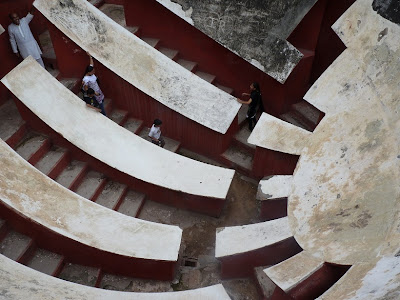
My slutwalking on Sunday took me to within a stone's throw (well, if you're me, around 7 stones' throws) of a Delhi sight I'd been curious to see for a while: the brilliantly named Jantar Mantar (though the pronunciation is closer to Junter Munter). It dates from the early 18th century and is basically a big observatory - a set of oversized instruments designed to measure the declination of the sun and various other heavenly bodies, as well as measure the time of day to within half a second. A 300-year-old Jodrell Bank, if you will. It is smack in the centre of Delhi and makes for a quite surreal side trip from the nearby shopping mecca of Connaught Place.

The complex looks rather like someone decided to build a grand mansion, started with all the staircases, threw in two large jacuzzis, some tucked-away servants' quarters and a couple of scale models of the Colosseum, and then got bored before he could add in all the bits in between:


Walking among these bizarre structures, full of mysterious crevaces and stairways to nowhere, it's hard to believe they were actually designed to have a functional purpose. It's more like you've accidentally wandered into an unfinished Escher painting:


There are five Jantar Mantars scattered across northern and central India, all built by Maharaja Jai Singh II of Jaipur, who must have been a learned if somewhat eccentric chap. Apparently the only one still working is the one at Jaipur (though this begs the question as to what the others are lacking that means they don't work: did the batteries run out?).

Anyway, bizarre though the structures look, it's refreshing to visit a historical site that stands testament to one man's commitment to scientific enquiry and intellectual pursuit, rather than his vainglory (which, let's face it, lies behind a great deal of the architectural and historical treasures we have in this world). Even if the science behind it is beyond me - or at least beyond the ability of Delhi sign-writers to make it comprehensible for laymen like myself.

And it makes for some pretty cool photos, too.

Saturday, 23 July 2011

National museum artefacts 5: a guest appearance

Haven't done one of these in a while, but I still have a good few things worthy of comment (and am planning a return trip to the museum before too long!).

Anyway, one of the joys of the museum is its section on Indian miniature paintings. They're fascinating portraits of life in a vanished society - the court of the Mughal rulers of Delhi who preceded the arrival of the British. They are particularly interesting because the Mughals were Muslim, but their art features some of the loveliest renditions of the human form you are ever likely to see - not normally something associated with Islamic art (they were also responsible for some of the most beautiful architecture in the world, including the Taj Mahal). The paintings don't really lend themselves to casual photographing, but you can see some lovely examples here.

One of the examples listed there really intrigued me, and it was this one:


At first sight the main thing you notice is the beautiful gold leaf script and decoration surrounding the central portrait, which represents one of the Mughal emperors, Jahangir (1605-27). The portrait itself is revealing: you might expect an early 17th century emperor of Persian and Mongolian stock to be depicted as a warrior, but what we see is a sensitive and artistic-looking young man - clearly someone who valued culture above conquest (despite this, he apparently enlarged the empire significantly during his tenure as top banana). But when you go for a closer look at Jahangir you notice that what he is holding is a bit unexpected:

She gets everywhere, doesn't she?

Yep, it's the virgin Mary, in the familiar meek-and-holy posture in which she is depicted in churches across the Christian world. But what's she doing in a portrait of an Islamic ruler, far distant from the nearest centre of Christianity?

Turns out we have a Brit to thank for this, though one who shared his culture with India in a rather less brutal way than his successors. Thomas Roe came to Jahangir's court as ambassador for King James I in 1615, bringing with him several paintings with Christian themes. Clearly they caught Jahangir's eye to the extent that he commissioned the above portrait.

This fascinates me for what it says about the culture of the court in Delhi at the time. In England, we'd recently had Elizabeth's persecution of Catholics (and Queen Mary's persecution of protestants before that), and we still had jolly old Olly Cromwell, that paragon of religious tolerance, to come. But in Islamic Delhi, the emperor was having himself painted with an icon of a foreign religion (actually, interesting question: I know Jesus is recognised as a prophet by Islam, but anyone know what it has to say about Mary?).

Of course the Mughals also pulled off the rather unusual feat of ruling for centuries over an empire that was overwhelmingly of a different religion to them, apparently without serious efforts to covert their subjects (though they had wars aplenty with neighbouring Hindu dynasties). The contrast with the ruthless efforts to suppress dissenting religious views in England (and elsewhere in Europe) at the time is striking, and shows just how recent an arrival tolerance is to our now-cosmopolitan society.


Sunday, 17 July 2011

Delhi's lost Oxbridge

I took a walking tour today round Hauz Khas, the most enjoyable district of South Delhi I've been to yet. The guide, Kanika, was a young woman with that charming, peculiarly Indian way of speaking that is just wonderful to listen to. Her history of Hauz Khas was peopled with "terrible chaps" and "mellow fellows" who said "nothing doing" in response to their subjects' misbehaviour and asked them "not to be carrying out any coups, please". All delivered in the smooth, melodic, Indian-accented tones that are one of the pleasures of living here.

Anyway, Hauz Khas. The name translates as "royal reservoir". The reservoir still exists, though much smaller than it used to be, and the village (which now sits bang in the middle of a huge deer park) grew up around the Madrassa (Islamic theological college) that clings to its Eastern and Southern shores.

Delhi is full of surprises. When you first arrive here it seems so ugly: sprawling, messy, dirty and noisy. The more time you spend here though, the more beauty you uncover. The madrassa at Hauz Khas was founded in the fourteenth century, about 150 years after Cambridge split from Oxford, but in its day it must have been easily as beautiful, tranquil and scholarly as those longer-lasting institutions. And it's still breathtakingly lovely.

Back when the reservoir was bigger, the madrassa buildings were constructed directly on the water's edge. You can still see the stairwells from which teachers and students must have launched boats. The buildings are Tughluk in style, meaning they are built from the hard, difficult-to-carve local stone, solid in style and simple in decoration. But the whole effect is graceful, stately and tranquil. It doesn't take much imagination to see this as a seat of learning, with earnest scholars listening to instruction to the sound of the lake lapping the foot of the walls below.


Since the madrassa was founded, history has marched back and forth over Delhi innumerable times. The teachers and students who lived here were long since kicked out of its way. As I walked around the still-beautiful ruins, I felt enormously lucky to be from a country where ancient institutions of learning survived the centuries, and particularly so to have been able to study at one of them. Who knows what learning would have come from the shores of this lake if history had been different?

Saturday, 9 July 2011

Pomp and circumambulation

I did quite a lot today. Having decided on another "tourist Saturday", I hopped on the Metro and headed up to the heart of New Delhi, the Rajpath, at the centre of the bombastic capital designed by Lutyens for British India and still the heart of power in India. Over the course of the day I ambled up and down the Rajpath and Raisina Hill (which leads up to the home of the Indian president), carried on to the National Museum, and then walked through the leafy avenues of New Delhi to lovely Lodi Gardens, through the park and on to the India Habitat Centre for dinner at the (impressively accurate) "All American Diner", before hopping back on the Metro at Jawaharlal Nehru Stadium (the one built for the Commonwealth Games).

That's not a bad walk for this climate, and I have to admit by the time I got to the park I was flagging. The inhabitants of Delhi think I am bonkers for wanting to walk anywhere at all. My landlord, who is lovely, tried and failed this morning to hide his view that my tendency to walk the 10 minute journey from my flat to the Metro station to get around town was a plain indication of my lunacy. In Delhi, the only people who walk are those who have to (this is still, it should be added, an awful lot of people). Everyone else is either in their car, on their bike, sitting in a tuk tuk, taxi or rickshaw, or driving them. And if you're white and anywhere NEAR a road, however much you think you are just pottering along minding your own business, what you are actually doing (as far as all the tuk tuk and rickshaw drivers are concerned) is carrying a large sign that says:

I AM A DESPERATE, LOST FOREIGNER WHO WILL PAY THREE TIMES THE GOING RATE. PLEASE, PLEASE, PLEASE FOLLOW ME DOWN THE STREET RINGING YOUR BELL INCESSANTLY UNTIL I COME TO MY SENSES AND GET IN YOUR RICKSHAW. IF I SAY NO, I DON'T REALLY MEAN IT. KEEP TRYING.

The thing is, Delhi is actually for the most part quite a walkable city - especially the parts I visited today. Admittedly crossing some of the roads can be a hair-raising experience, but with a decent map navigation is unproblematic and it compares favourably with walking in a lot of other Asian mega-cities (I still shudder a bit at my memories of trying to walk round Bangkok).

But try telling that to the people who live here. I'm not the first person to experience this bafflement in the face of someone who actually enjoys being able to walk around the city at my own pace - Sam Miller's book Delhi: Adventures in a Megacity is based on his experiences of doing just that for a year (nice life these journos have) and I'm pretty sure he had to fight off legions of rickshaw wallahs every day.

Anyway, enough about walking. Having packed in a lot of stuff I have a lot to blog about, so I am going to be sneaky and use a lot of it as ammo for future days when I can't think of anything decent to write (see Tuesday and Wednesday this week). So for now I'll just talk about the Rajpath and New Delhi.

I think of all the bits of Delhi I've seen so far, the Rajpath is far and away my least favourite. Don't get me wrong, it's very impressive. The buildings are magnificent and suitably awe-inspiring; the scale of the broad mile-long avenue running from the Rashtrapati Bhavan (the President's home, formerly home to the Viceroy of India) to India Gate is as immense as anything I've seen anywhere else in the world and makes the Champs Elysee look like a back alley. But the whole place just feels wrong.

Part of it is that there's just too much space:


The Rajpath and its surrounding lawns are so wide (I'd say at least 120 metres, though I'm not much good at estimating such things) that walking there, even when the sun is not too bad, makes you feel kind of like this traffic light (which is situated at Vijay Chowk at the bottom of Raisina Hill):

That is, isolated, exposed, and liable to get utterly drenched should the monsoon rains make an appearance (they did, but I was rescued by a friendly tuk tuk driver who - bless him - offered to take me somewhere for free as "it is a human right to stay dry". I got him to take me round the corner to the National Museum and paid 20 rupees for a 45 second trip).

The second thing is the lack of people. I know this was a Saturday and I'm sure it's busier during the week, but I can't quite believe that enough people ever come here (except for the big parade on Republic Day) to fill that yawning vacuum of space. Today there were a few lacklustre guards, some underwhelmed-looking tourists, a few families lounging in the grass, and a lonely ice cream man (I bought an ice lolly and then came back for another). Combined with the self-important architecture and the vast expanses of tarmac and patchy grass, the lack of people gives the place an austere, desolate air quite unlike the rest of the city.

In fact, although the Indians have taken the colonial infrastructure here and made it their own, that's the problem: it doesn't fit. It looks and feels like a massive colonial folly (I don't include all of New Delhi in this, by the way, a lot of which is really quite lovely) and is at odds with the packed, hardworking Indian city around it that is by turns elegant and squalid in equal measure. I don't blame India for doing this: in fact they are to be praised for embracing history and taking charge of it, rather than seeking to erase it (as in Seoul, where Japanese colonial buildings were torn down without regard for historical or aesthetic value). I just find the whole ensemble rather alienating (come to think of it, maybe that was the idea).

(On a side note, all my guide books tell me that Lutyens wanted the Rashtrapati Bhavan to be visible all the way up the Rajpath, and was really annoyed when he realised it only comes into view when you get towards the top of Raisina hill. Having been there, I have this to say: Lutyens was a bloody idiot. If you stick a big building on top of a hill but set it several hundred metres back from the summit edge, it's going to have an impact on its visibility from below. It's not rocket science. Greatest British architect, my aunt Fanny.)

Anyway, here are a few more photos of the Rajpath area if I haven't totally put you off (by the way, the National Museum and Lodi Gardens were both amazing, so subsequent posts will get a lot less critical...)

The Viceroy moved out, the President moved in. If you ask me, it's hard to see why either of them would need so much space.

*Insert metaphorical caption about Indian democracy*

No presidential residence is complete without pachydermal topiary.

Get out of the road, crazy white man!

I was going to upload a couple more but the connection speed has just dropped through the floor, and this post is probably long enough already anyway. Don't worry, lots more to come!

Saturday, 2 July 2011

Two sides of Delhi: Humayun's tomb and Nizamuddin

True to my word, I did touristy things for the first time today. After a few days of cooler weather the thermometer had bounced back up again, so it took me a while to get going. But gosh, I'm glad I did.

So first up: Humayun's tomb. It dates from the mid-16th century and sits in a frankly gorgeous setting, surrounded by parkland in an area that appears to be one vast Mughal mausoleum, so many beautiful tombs and monuments are dotted around the landscape. It's very central in the city but the peace in the gardens is just lovely. And very welcome for those of us who occasionally feel a little worn down by Delhi's urban clamour.

Before I got there, though, I experienced my first serious brush with Delhi's monsoon rains. I'd walked to the tomb from the metro and was feeling hot, sweaty and a bit headachy, so a ferocious downpour was in theory highly welcome. Unfortunately I also had my Kindle, mobile phone and camera in my bag, whose waterproofness I decidedly do not trust.

Happily the rains came just as I got to the ticket booth. This was not particularly effective as a shelter however, as the rains were more or less horizontal, and the ticket booth was not exactly designed to be waterproof either:


So there I was, stuck under a corrugated iron roof between two concrete walls open on three sides, with the Delhi monsoon unleashing its full rage upon me. Admittedly the views were lovely:


...or at least they were until a whole load of other visitors to the tomb showed up, and the views were replaced with a nose-to-armpit acquaintanceship with some very damp Delhiwallas:


Others, though, thought the rains were the best thing that had happened to them. Ever!


I defy you not to smile at these pictures.

Anyway, eventually the rains wore off and we squelched out to carry on into the tomb complex. I won't bore you with tons of photos of the tomb, but suffice to say that when I emerged from the West gate and saw it for the first time, I was so stunned I nearly walked straight into this:


Which would, I am sure, have been highly amusing for my fellow visitors but made relatively little difference to my already soggy state.

Anyway, back to the tomb. This is quite simply one of the most perfectly beautiful buildings I've ever seen. It's known as a precursor to the Taj Mahal, which I've yet to go to, and all I can say is if this is the rehearsal I can't wait to see the show. My photos don't to it justice, but I have to post at least one:


I spent a very happy couple of hours mooching around the building and admiring the gorgeous layout of the grounds, the wonderful use of sunlight in the interior, the patterning of the walls...and of course the peace! I have to admit that my expectations were not all that high, having been very disappointed by my visit to the Red Fort on my first visit to India back in January (it just felt a bit depressing, mainly thanks to the "improvements" imposed upon it by, yup, the British) but Humayun's tomb blew me away. My first real taste of the richness of India's architectural heritage.

A very different side to India lies across the road from the tomb. Searching vaguely for something to eat, I found myself in Nizamuddin - a district that exists because of the community of the faithful that grew up around the tomb of the Sufi saint who gave the area its name. This is Delhi at its most confusing, fascinating and intimidating, and I have to admit I was a bit overwhelmed - though not as much as the two Belgian girls hovering near the entrance from the main road who at first asked me to escort them in and then three minutes later, having decided I wasn't sufficient protection, chickened out and scurried back the way they had come.

The reason for this nervousness? There was not a single woman in sight: dozens of muslim men, a sea of white skullcaps, taqiyah skullcaps, milling through a warren of densely packed streets through fruit stands, butchers, rubbish heaps, random goats, flower stalls and incense-stick-choppers. And more flies than I have ever seen anywhere. I didn't take many photos, feeling a bit apprehensive about how it would be received, so this one doesn't really convey the atmosphere all that well. But it's the best I've got:


As far as I could see there was absolutely no hostility towards us, but I could understand the girls' nervousness (especially since they were not exactly dressed in burkas). But I ploughed on into the melee.

I am at a loss as to how to describe Nizamuddin. Suffice to say I am resolved to go back one day when I'm less hot, tired and sweaty and take my time over it a bit more. Today it was just sensory overload - so many sights, smells, sounds and sensations that my brain couldn't take it all in. India feels very foreign to me, of course, but never so much as here. Just the idea of the place - a suburb of a capital city that does not only originate in a religious movement, but that continues to revolve around it nearly 2000 years later - I find extraordinary.

I drifted through the alleyways - at one point almost managing to blunder my way into a shrine without removing my shoes, though in my defence it looked pretty much like an arcade of shops from the entrance - and let it all wash over me. I'm normally painfully shy around street traders but I managed to buy some tomatoes from this chap (though I think he probably ripped me off):


I didn't feel unsafe - just very, very foreign. When I emerged onto the main road again, it was 4.30 pm and I was feeling a little bit peaky (overdoing it in the sun, Chris - you know you shouldn't do this) so I hopped in a tuk tuk back home. And got under a long, long, cold, cold shower.

So, two places visited, two places marked down for return visits: not bad going. And there is so much more to see here in a city that has been built, lost and reincarnated around a dozen times. I can't wait.