Showing posts with label neighbourhoods. Show all posts

Sunday, 4 September 2011

Can you hear the drums, Fanindra?

Apologies for the frankly appalling post title. Actually no, I take that back - gratuitous Abba references are nothing to apologise for. And this post is all about drums.


I'm just back from a very enjoyable evening in Hauz Khas with a friend of an old friend of mine from school (one of the advantages of growing up in multicultural Manchester is that friends of friends are to be found all over the place). He took me to the Delhi Drum Circle, where anyone with a drum can turn up to the park next to the madrassa and beat out some rhythms. It was a lot of fun (and made me think about buying a drum, which I've never really considered before) with a whole range of Delhi citizens of all ages:


(This was by far the most popular of the participants, a very stately and dignified old Sikh gentleman who got down and shook his thang like a teenager. Needless to say he was whooped and cheered to high heaven every time he did so.)


There were also some very impressive acrobatics from this chap who wielded a staff that was set alight at both ends:


The rhythms came thick, fast and fierce as the surrounding parkland gradually darkened, and the crowd pressed in around the drummers clapping and tapping along. There's something very primal about drumming, and it has a way of creating a feeling of unity among a group of strangers that has a magical quality to it. As we huddled together under the threatening monsoon skies, there was an undeniable power hanging over the crowd that had the circle of beating hands as its focus and that reflected in the eyes of everyone there. It was next to impossible not to move your body in some way, and while I didn't go much further than some appreciative foot tapping, we were treated to some pretty wild dancing from some of the ladies present:


...which inspired some to go to some effort to get a better view.


In some ways the evening was a reflection of the city. This is not traditional India: the Drum Circle concept originates in the USA, and as my new friend Rishneet pointed out, across much of the country the women having such a good time tonight would be castigated for their behaviour. Even the instruments were, for the most part, of African rather than Indian origin. But the Punjabi rhythms and the love of dancing are a quintessential part of the makeup of the country, so it's no surprise that the event has become so popular. So Delhi: a city subject to increasingly cosmopolitan influences, the face of a country with an increasingly global outlook, but with its cultural roots firmly entrenched despite centuries of foreign domination.

The evening was rounded off perfectly with dinner at the Gunpowder restaurant in Hauz Khas, which served up a fantastic Keralan fish curry and a paratha so light, fluffy and tasty that it rivalled those at my much-missed local restaurant in Peckham, Ganapati. Hauz Khas scores a hit again!

Tuesday, 16 August 2011

Old walls and old wells

I still
cannot get over the sheer number of ancient sites and monuments in Delhi. We Europeans tend to think of Asian cities as modern affairs - either squat concrete or shimmering steel-and-glass - and that Europe is where you go for truly old urban architecture. But there are few places in Europe that come close to rivaling Delhi's wealth of heritage buildings - as a few posts on this blog have attested.

My latest bit of exploration into Delhi's history is probably the most dramatic - the Purana Qila or Old Fort, which lies north of Humayun's tomb and south-east of India Gate and the Rajpath. As with Old Delhi, the "Old" bit of the name is not really accurate: this is the site of the sixth of the cities that have stood here, and was Humayun's (he of the beautiful tomb) centre of power in the sixteenth century (though it is reputedly also where the first city, Indraprastha, stood). It's also where Humayun met his end - after falling down a flight of steps, which seems a cruelly undignified way for a man of his standing to go. Its massive walls tower dramatically over this part of Delhi, and the main gate was clearly designed to impress:


There's not much that survives inside the walls though, other than Humayun's graceful little observatory and a mosque, dramatically positioned overlooking the valley of the Yamuna river and featuring some wonderful mosaic work on its facade.


From its defensive position, the Purana Qila looks down on the whole valley - although the river itself has shifted course away from its walls these days. Of course, nowadays the valley features some rather less beautiful architecture, which provides some interesting contrasts:


The once-impregnable fortress is now a favourite spot for an evening stroll for the citizens of Delhi, who come and have their photos taken outside the ancient buildings. As you can see, the occasion gives rise to unmitigated joy and gay abandon on the parts of the participants:


But if you don't fancy a walk and would rather a sit-down activity, you can always opt instead to take a boat around the slightly swampy-looking boating lake that sits at the north-west foot of the walls. It looks like a pleasant excursion, but I can't help thinking that the sight of these garishly coloured pleasure boats and giant ducks pottering about beneath the towering, defensive ramparts looks a bit incongruous. I wonder what Humayun would have thought of this particular usage of his citdael.


Finally, just outside the main gate to the Purana Qila is the Khair-ul-Manazil, or "best of houses", a now rather dilapidated mosque and madrassa, which apparently was commissioned by the wet nurse of one of the Mughal emperors (I never knew wet nurses could be so powerful outside of Blackadder). The building itself doesn't stand out greatly against Delhi's other monuments, but it does feature a working hand-drawn well, which was being put into use when I popped in for a visit:


This is one of the things I find so fascinating about Delhi - in a rapidly modernising city, older ways of life still flourish. There is always something happening, wherever you are, and few things are allowed to go to waste. In the middle of a semi-derelict historic site, a working well that produces clean water (well, it looked clean anyway) and a family making use of it. The guard came in just after I took this photo and was given some of the water to wash his hands and mop his forehead. What they used the rest of the water collected in the urns for I have no idea - but I was happy for the photo op.

Tuesday, 2 August 2011

Delhi's strangest attraction?

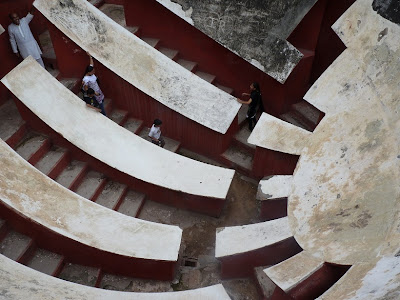
My slutwalking on Sunday took me to within a stone's throw (well, if you're me, around 7 stones' throws) of a Delhi sight I'd been curious to see for a while: the brilliantly named Jantar Mantar (though the pronunciation is closer to Junter Munter). It dates from the early 18th century and is basically a big observatory - a set of oversized instruments designed to measure the declination of the sun and various other heavenly bodies, as well as measure the time of day to within half a second. A 300-year-old Jodrell Bank, if you will. It is smack in the centre of Delhi and makes for a quite surreal side trip from the nearby shopping mecca of Connaught Place.

The complex looks rather like someone decided to build a grand mansion, started with all the staircases, threw in two large jacuzzis, some tucked-away servants' quarters and a couple of scale models of the Colosseum, and then got bored before he could add in all the bits in between:


Walking among these bizarre structures, full of mysterious crevaces and stairways to nowhere, it's hard to believe they were actually designed to have a functional purpose. It's more like you've accidentally wandered into an unfinished Escher painting:


There are five Jantar Mantars scattered across northern and central India, all built by Maharaja Jai Singh II of Jaipur, who must have been a learned if somewhat eccentric chap. Apparently the only one still working is the one at Jaipur (though this begs the question as to what the others are lacking that means they don't work: did the batteries run out?).

Anyway, bizarre though the structures look, it's refreshing to visit a historical site that stands testament to one man's commitment to scientific enquiry and intellectual pursuit, rather than his vainglory (which, let's face it, lies behind a great deal of the architectural and historical treasures we have in this world). Even if the science behind it is beyond me - or at least beyond the ability of Delhi sign-writers to make it comprehensible for laymen like myself.

And it makes for some pretty cool photos, too.

Thursday, 28 July 2011

Sensory overload in Old Delhi

What with all the excitement this week I never got around to posting about last weekend's bit of exploration. It was a return trip this time, to what is commonly know as "Old Delhi", though it is in fact substantially younger than a lot of the bits of the city I have already written about.

Old Delhi grew up as Shahjahanabad in the 17th century, to the west of the Red Fort, and was the last capital of the Mughal empire. It's the birthplace of the Urdu language and in its day was apparently a graceful city full of beautiful palaces and serene canals.

That's hard to imagine these days. After my first visit in January, when I battled up and down the main thoroughfare, Chandni Chowk, and left feeling more sweaty and tense than anything else, I was far from sure that I wanted to go back. But, aware that I hadn't really given the area much of a chance to endear itself to me, I decided to give it a go.

Old Delhi is the very antithesis of it southern neighbour, New Delhi, with its wide open spaces and grand airs. It is crowded, frenetic, intimidating and overwhelming. Everywhere you look, people are engaged in commercial activity. Everything is on sale in Old Delhi, much of it concentrated in highly specific bazaars, so that if you know where to go you can be sure to find what you are looking for. The people are different here: raucous, pushy and occasionally a bit dodgy: this is the only place in Delhi where I have found myself consciously keeping an eye on my bag. The kids elsewhere in the city stare at me; here, they ran after me down the street calling me a rascal (at least, I think that's what they were calling me).

The street layout of Old Delhi is a true labyrinth. There's no point trying to navigate; you just have to wander where your feet take you and trust that eventually you will emerge somewhere near a recognisable landmark. That is if you survive without being run over by a bike, scooter, rickshaw or wagon, all of which career along the narrow alleys like they're on the M1 and only stop when absolutely forced to (usually because they are in each other's way):


The buildings are mostly twentieth century and uninspired, though every now and again Old Delhi taunts you with a hint at the beautiful architecture of its past that lingers in scraps in its present:


There must be a thousand secret routes through the streets of old Delhi. Apart from the alleys and lanes themselves, mysterious flights of stairs hint at first-floor walkways, and countless gateways lead to hidden courtyards. A favourite scam played on foreigners here is to offer to guide them to some sight and then lead them down into the bowels of Shahjahanabad to rob them, knowing that however fast they are they will never manage to negotiate the maze to catch up with a fleeing mugger. Unsurprisingly, this generally works.


In the middle of all of this sits one of the greatest treasures of Delhi: the Jama Masjid, India's largest mosque (and given that India has the second-largest Muslim population in the world, there are some big mosques here). It is enormous - it takes about twenty minutes to circumnavigate - yet the surrounding streets are so densely packed that finding it proved trickier than I had anticipated. Eventually, though, the alleys gave way to the ochre minarets and white domes of the mosque, sitting serenely amid the maelstrom:


The serenity doesn't last long though, because right outside the main entrance to the mosque is the Meena Bazaar, one of the busiest wholesale markets in the city. The view from the mosque down the wide steps and boulevard leading up to it is like looking at an Indian Where's Wally ("Where's Wali"?):

It was a slow day down the shops.

I have to admit that braving the crowds was a bit of a challenge for me (as anyone who's been on the tube with me at rush hour knows, I'm not all that great with lots of people in close proximity). But once I'd done so there were just too many extraordinary sights, sounds and smells to worry about claustrophobia. I was particularly taken with the stalls selling an extraordinary diversity of nuts, scattered in heaps on cloths spread out on the ground:


And the rather lovely kites on sale, fluttering on lines above the busy shoppers' heads, also caught my eye:


But my absolute favourite was a mystery to me. Slightly removed from the main drag, a rather portly gentleman had set himself up next to a waterlogged parking area. In front of him was a huge bubbling cauldron filled with a reddish-brown sludge, and arranged around him like a defensive wall were around 20 pots of various spices and nuts. Speaking in a gravelly, hoarse voice, he kept up a constant salesman's patter to a crowd of some forty men like some kind of Indian Frank Butcher. Every now and then one of his assistants would get up and add something else to the swampy concoction, on which the eyes of the crowd were fixed like glue:


Sadly, after four classes my Hindi is not quite up to following such rapid-fire hard sell, but I did catch a few mentions of the words for "Indian", "children" and "boy". Given that all the watching crowd were male, I'm hazarding a guess that the pots of goo he doled out when his pitch was over were intended to boost fertility, and in particular to guarantee conception of a son. I could be wrong (if anyone knows any better please enlighten me!) but whatever the purpose of the product was, it was a fascinating spectacle.

Anyway, I left Old Delhi for the second time feeling rather more positively disposed towards it. I would still go back there with a certain amount of apprehension and with a careful eye on my possessions and moving objects in the thoroughfare. But I will go back, because it can't be denied that this Delhi is the most vividly, excitingly alive of all the Delhis I've seen so far. You just have to take a deep breath, dump the map and jump on in.

Monday, 18 July 2011

Behind the walls

Another post about Hauz Khas...a different side of it.

Most people visiting Hauz Khas don't get beyond the beautiful ruins, the lake and the deer park, or the high-end boutique shops in the village. They don't venture further south, where the painted signs stop and the narrow alleys take you behind the high madrassa walls, to a different Hauz Khas - one that feels like it's been transported a couple of hundred miles from rural India.

In this Hauz Khas, dozens of children run in and out of rows of tiny, one-storey houses and among the bicycles, piles of wood, old tires and empty wagons scattered around the streets. Mysterious green and orange concoctions bubble away in ancient bowls over open wood fires. Weary women sit in front of their houses, having mud plastered into their hair. Goats trot along the tops of the roughstone walls. And all around, the birds and insects of the woods keep up a constant chirping.


It really does feel like you've left Delhi far behind. Even around the madrassa, which is far quieter than the rest of Delhi, car horns can be heard every couple of minutes and there is a constant coming and going. But behind the walls, there are no horns, few cars and fewer visitors: this is a working rural village incongruously planted in an urban park.


I didn't take many photos here. I'm very conscious that places like this are not a tourist attraction and that the people around me are in their space, living their private lives. But of course the local kids have no such qualms and ran after me yelling "one photo! one photo!" till I relented, and then mobbed me to get a look at the results:


There are hidden worlds all over Delhi, away from the main roads, the markets and the well-heeled areas known to the expat community. At times, the city can feel almost small - the areas where you're encouraged to go as a foreigner being limited in number. But of course it's immense - 17 million people call this city home, twice as many as the populations of Scotland, Wales and Northern Ireland combined. And much of it is pretty much a closed book as far as foreigners are concerned.

The tourist guides to Delhi take you to the centre (Old Delhi and the Red Fort), New Delhi to its South, and the leafy areas of South Delhi beyond that. Expat business people flock to Gurgaon, the soulless new city south of the metropolis. But the vast territories of Western and Northern Delhi may as well be a different planet. None of my guides refer to them. I know nothing about them except that a hell of a lot of people live there.

I have to admit that, although I do plan to go and have a look around one of these mysterious places on my map of the city, the thought is rather intimidating. Delhi feels very safe generally, but crime against visitors is not unknown here. And there is a violence to Indian history and society that seems at odds with the smiling faces you generally meet (not that smiles are an indicator of an unfamiliarity with violence - possibly the most smiley place I have ever been to is Cambodia). Delhi is, after all, supposedly India's crime capital - though this blog puts that assertion into perspective rather neatly.

More to the point, navigating Delhi's crazy streets is hard enough even in the relatively developed Southern parts, with a guidebook in your hand - I suspect the North and the West come with their own challenges. Happily, the ubiquitous rickshaws mean you never need to worry too much, as long as you can name somewhere from where you know your way. So with a year and 11 months (at least) to go before I leave Delhi, I really have no excuse not to venture beyond the Lonely Planet comfort zone.

Anyway, that's for another day. Some time when the weather is a bit kinder and my Hindi has improved...

Sunday, 17 July 2011

Delhi's lost Oxbridge

I took a walking tour today round Hauz Khas, the most enjoyable district of South Delhi I've been to yet. The guide, Kanika, was a young woman with that charming, peculiarly Indian way of speaking that is just wonderful to listen to. Her history of Hauz Khas was peopled with "terrible chaps" and "mellow fellows" who said "nothing doing" in response to their subjects' misbehaviour and asked them "not to be carrying out any coups, please". All delivered in the smooth, melodic, Indian-accented tones that are one of the pleasures of living here.

Anyway, Hauz Khas. The name translates as "royal reservoir". The reservoir still exists, though much smaller than it used to be, and the village (which now sits bang in the middle of a huge deer park) grew up around the Madrassa (Islamic theological college) that clings to its Eastern and Southern shores.

Delhi is full of surprises. When you first arrive here it seems so ugly: sprawling, messy, dirty and noisy. The more time you spend here though, the more beauty you uncover. The madrassa at Hauz Khas was founded in the fourteenth century, about 150 years after Cambridge split from Oxford, but in its day it must have been easily as beautiful, tranquil and scholarly as those longer-lasting institutions. And it's still breathtakingly lovely.

Back when the reservoir was bigger, the madrassa buildings were constructed directly on the water's edge. You can still see the stairwells from which teachers and students must have launched boats. The buildings are Tughluk in style, meaning they are built from the hard, difficult-to-carve local stone, solid in style and simple in decoration. But the whole effect is graceful, stately and tranquil. It doesn't take much imagination to see this as a seat of learning, with earnest scholars listening to instruction to the sound of the lake lapping the foot of the walls below.


Since the madrassa was founded, history has marched back and forth over Delhi innumerable times. The teachers and students who lived here were long since kicked out of its way. As I walked around the still-beautiful ruins, I felt enormously lucky to be from a country where ancient institutions of learning survived the centuries, and particularly so to have been able to study at one of them. Who knows what learning would have come from the shores of this lake if history had been different?