Friday, 30 September 2011

Colours of the city

As with any big city, Delhi has its fair share of grey. Historical treasures aside, much of the architecture is fairly uninspired and the rapid expansion of the city has led to a proliferation of (usually fairly potholed) tarmac that generally lurks behind a fug of exhaust fumes. But Delhi is nevertheless a city of colour. It's everywhere, and the flashes of brightness that one experiences every day here are one of the things I love most about it.

Firstly, and most obviously, green. You might not believe it as you enter the city on the 8-lane highway from the airport, but Delhi is one of the most luxuriantly green cities I've ever been to. A lush canopy hangs over much of the city, which becomes apparent when you go up a flyover or ride the metro and realise that much of the city is obscured from view beneath the foliage, with taller buildings rising up like lost jungle citadels.


Green is also represented by the parrots that flock all over the city, ignored by Indians and cooed over by tourists who spend significant amounts of time trying to snap them in mid-flight (OK, I do this too). Given that my point of comparison is the mangy, grimy pigeon population of London, I have to say that I think most Delhiwallas don't fully appreciate these flashes of emerald darting about above their heads.


Yellow is another colour I  associate with the city, because it's such a popular colour for clothing. Of course, people here - particularly the women - take tremendous pride in their clothes and you can't walk down the street without running into three or four ladies dressed in graceful, vibrant saris or salwar kameez that would turn multiple heads in London. But my favourite is the deep, golden yellow in the photo below, which you see everywhere and which I love because it looks so wonderful against Indian skin tones (I've always liked yellow but rather fear that most white people just can't get away with it):


And it's not just the women who know how to use that splash of colour to have an impact:


Indian women's sense of style knows no bounds of age or class. While you can always see when a woman has money by the fineness of the fabric she wears, even simple and coarse cloth is worn with aplomb and dignity. Older ladies are often even more carefully turned out than their younger counterparts, though there is a discernable tendency towards floral patterns among the senior generation (you see the same sort of thing with wallpaper in the UK...):


Not all the colours sported by the city's denizens are so aesthetically pleasing. The picture below represents a sight that is, sadly, all too common among Delhi men of a certain age. This particular predilection of the Indian middle aged male is entirely baffling to me.

With apologies to the brilliant lifeandlentils blog for nicking the photo!

Indians also have a knack for using the most mundane objects to add a bit of vibrancy. I love the pink hue of many of the city's old monuments, but I was particularly taken with the multicoloured row of water jars sitting outside this mosque at the Qutub Minar (the squirrel was an added bonus):


And I especially liked the way the purple jar exactly matched the pattern on the rug in front of the mosque:


I could write a very long post trying to catalogue all the colours of Delhi, and how much they brighten up my days, but it's getting a bit late and I'm flying back to grey old London tomorrow. So I will keep some back for future posts. I may go a bit quiet for the next couple of weeks while I'm away from Delhi, but I will be back in mid-October and keen to reinvigorate the blog. Please keep reading!

Wednesday, 28 September 2011

Demob Happy

Goodness, it's been a long time since my last post. I feel quite ashamed. Those heady days of daily posting in the first half of September seem like a distant memory. I hope you haven't been pining without me.

A number of factors have combined to make my blogging less prolific than in the past. It's been a hectic few weeks at work, with trips to Bangalore and Kolkata as well as my first public speaking engagement in India, which was a bit of a nerve-jangler in many ways. The Bangalore trip ended up being a good deal more stressful than it needed to be after I left my beloved Kindle on the plane on the way down (I got it back, but only after a display of tenacity and, at times, tooth-bared snarling that would make your average dog with a bone creep away in embarrassment). While all this has been going on, my colleague has been less available than normal due to some family issues, so I've spent quite a bit of time trying to do two people's jobs in half the normal working time. Not only has this eaten into the time available for blogging, it's also eaten into the time available for having experiences worth blogging about (board meetings and practicing my speech just don't really cut it).

In addition to work, my first foray into the Delhi theatre scene is underway as I've begun rehearsals for my short play, which I am directing as part of the Short + Sweet festival in November. I've missed doing theatre and I'd almost forgotten how energising it can be. So far it's going OK - it's early days but my two leads are doing great work, although I don't get to enjoy the kind of facilities you lucky London theatre types do (the festival is being staged in a conference venue rather than a theatre, and the rehearsal space is my living room). Unfortunately I've just lost my third cast member, so if anyone happens to know any actresses in Delhi interested in a small but pivotal role in a short play about neurotic shop dummies planning to take over the world, just let me know...

At the same time, my domestic life has become a bit more complex following the arrival of my stuff from London. Having lived for the last couple of months living, as my landlord Mr Mehandru rather disdainfully puts it, "like a Bohemian", with minimal furniture, a suitcase full of clothes and a sleeping bag, I've been unpacking and finding a home for all of this (plus a couple of extra boxes of kitchen stuff):


I have of course had some relaxation time, but (and I know this is a crap reason for not blogging, but in the spirit of honesty) over the last month quite a lot of it has been taken up by *ahem* working through the first three seasons of Angel, which a friend of mine lent me in London and which I have to give back to him very shortly. This is because - and this is a lot of the reason why my blog rate has flagged recently - I've promised to bring them with me when I head back to London on Saturday for two weeks, followed by a few days in The Hague (which feels at least as much like home to me). It's been a bit of a race against time, but I think I've just about managed it.

The closer Saturday gets, the more I notice my thoughts focusing on things like the friends I'm going to catch up with, the cafes I'm going to go back to, and the lovely lovely lovely cold British weather (I'm totally serious) that I get to enjoy. And conversely, the less I am watching out for the quirky, the beautiful or the confusing in my immediate surroundings that make for blogworthy material.

I guess this is inevitable. I have a healthy spirit of adventure, but we all need our home comforts from time to time. Basically, my body may be in Delhi but my mind is increasingly in England. I love my palak paneer and badam milk, but right now I'd kill for a decent cup of coffee and some good cheese; the monuments of Delhi are stunning but I am missing the Victorian terraces of South London. You can still keep the tube though.

No doubt when I come back in mid-October I will rediscover my zest for all that Delhi has to offer, particularly as by then it should have begun to cool down a bit. Three and a half months of Delhi summer has made me crave chilliness like never before. I wish I had more time to get under the skin of the place though. I recently read this awesome blog about people living in the ruins in Hauz Khas and I just wish I could offer you something even a fraction as fascinating or photos the tiniest bit as gorgeous. I did pop into the bit of the ruins mentioned here, but didn't have the nerve to take any photos or to speak to the inhabitants. I guess I have a long way to go as a blogger.

Anyway, I wanted to post even though I don't have any pithy observations about India to make or encounters with eccentric locals to relate. Blogging is a tricky business and like any kind of writing the most important thing is that you are doing it. Even if every now and then that means that you end up with a kind of rambling and pointless post like this one. Bear with me. I'll get better again, I promise.


Sunday, 18 September 2011

Birds and bikes

It's been quite a week. A two day visit to Kolkata and a two day skills conference in Delhi pretty much meant that work took over all my time since last weekend, hence my paucity of postings. So it's now been over a week since Rishneet and his friends took me along on a day trip to the Keoladeo National Park in Rajasthan, about 200 km south of Delhi. It's a World Heritage Site known for its diversity of birdlife, and is long established as a refuge for migratory birds particularly during the winter season.

We were there during the low season, so there were no massive flocks to be seen. Indeed, in recent years the park has seen steep declines in the numbers of visiting birds, as the water supply to the park has dropped local demand for water has risen (the immediate vicinity is relatively densely populated). As a result, it's in danger of losing its World Heritage status unless current efforts to boost the water supply by the park management are successful.

Still, Keoladeo is a beautiful place to pedal around (despite my hire bike being about the right size for an 11 year old), full of lush green vegetation and punctuated by small lakes (a lot smaller than they used to be, apparently):


Our route took us past a place that pretty much encapsulates the extremes of India. I wish I had taken the time to get a better picture of this, but you get the idea:


The massive flocks may have been absent, but we did spot quite a number of birds, including green bee-eaters, grey hornbills, and (my personal favourite) a roosting flock of storks standing proudly silhouetted against the twilight sky:


The day also featured the ugliest and greediest turtles I have ever seen, who live in a lake in the grounds of a temple where they are fed by the temple keepers. Watching them approach the jetty where we were standing - a formless lump pushing ominously and rapidly towards us through the green surface algae like the monster in a B-movie - was genuinely unnerving, and those jaws looked powerful enough to keep us all well back from the water's edge:


The temple also hosted a religiously-inclined pig:


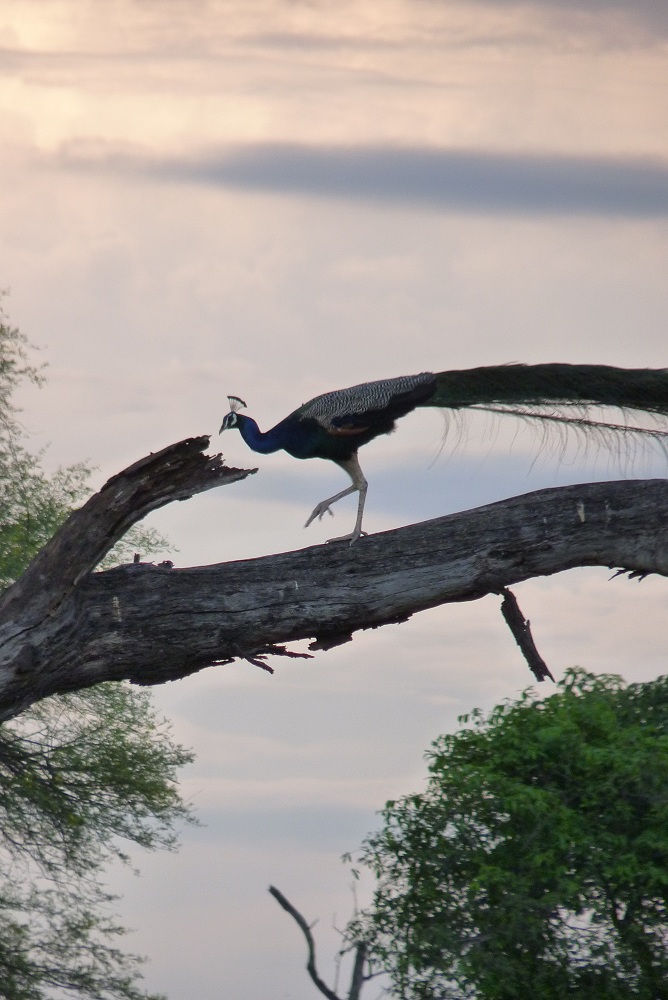
As a parting gift just as we were about to exit the park (very sweaty and with rather a nasty headache from overdoing it in the sun), we were treated to a beautiful sight as the sun approached the horizon. Peacocks are ten a penny in India, but this one just demanded to be photographed:


It was a (very) long and tiring day - we set off at 3 am from Delhi and we didn't get back until the same time on Sunday morning! Fortunately for me my companions were highly tolerant of my grumpiness on the trip back (the headache didn't help in this regard). Despite that, it was a great day and a completely different side of India - it would be nice to go back some time in the Winter months and see what the park is like in its peak season. 

I couldn't help but feel a bit sad, though, as I read about the park's troubles and its decline from its glory days. It seems like the price for development is paid most consistently by the natural treasures each country has, and India, being crowded as well as fast-developing, is more vulnerable to this than most. No surprise either that it is water that is the issue. India is one of the most water-stressed countries in the world, and its developing industries are inevitably exacerbating that demand.

As the ground water on which much of India depends becomes more fiercely contested, what chance do the migratory birds of Keoladeo have of getting their share? I wonder whether a visit to the park will be as rewarding in five or ten years' time, and whether Keoladeo can ever return to its former glory. Just another challenge on India's road to development.

Thursday, 15 September 2011

There is a corner of some Rajasthani field...

There are probably not many boys from Manchester who can say they have a thicket of trees in Rajasthan, but as of today I am one of them:


Take note, not just a tree but a whole thicket. Things don't get done by half round here.

Anyway, this was my reward for speaking today at a national conference on skills development organised by the Federation of Indian Chambers of Commerce and Industry, in lieu of a more conventional token of appreciation. I thought this was a rather nice touch. I wonder if it's possible to visit my thicket. Probably not, sadly.

Indian audiences have incredible stamina. My presentation came at the tail end of a very long day, but the hall was still close to full and the Indian attendees all sat ramrod-straight, apparently paying close attention to the content (it has to be said that the non-Indians in the audience fared less well in this regard, and gradually sank lower and lower in their chairs as we closed in on 7 pm. I don't blame them, it was only being on a dais that was preventing me from doing the same). It was nice to have an attentive audience despite being on the graveyard shift. And a thicket to boot.

Tuesday, 13 September 2011

Private acts, public accusations

Greetings from Kolkata airport, which has made a late new entry rather high in my list of depressing, drab and desolate aiports around the world (closely rivalling Moscow, Coimbatore and Luton), with special mentions in the "confusing layout" and "excessive number of passport checks" categories. I would love to blog about Kolkata, but I've been here on a two day business trip that has allowed no time for sight seeing. I will just give a quick commendation for the absolutely superbly named Hotel Rockstar, which I passed on  my way in from the airport and which, frankly, deserves to become an international chain on the basis of the name alone.

I may not have seen much of Kolkata, but I did get to stay in the rather splendid Taj Bengal, which has rooms built around an enormous atrium like the world's most luxurious prison, and which pays attention to the details. Like the little "things to do" reminder note on my bed when I arrived, which included tips like "confirm your flights" and "take your prescribed medicine", but which kicked off with "have you called your family today?" This inspired a minor twinge of guilt as I reflected that it had been some days since I called anyone in my family (although I have introduced my mum to the joys of Skype). Sorry, mum.

The Taj Bengal: the most luxurious guilt trip in India

It's very Indian to find that a hotel takes it upon itsef to remind you to stay in contact with your nearest and dearest. It's impossible to overstate the importance of the family here and how assumptions about family relationships inform every social interaction. "Proper" family relationships are subject to public sanction that show themselves in ways that range from small and harmless (as per the Taj's chirpy note) to quite horrifying (such as the ritual of Sati - supposedly still practiced in places - whereby a widow is expected to throw herself onto her husband's funeral pyre).

Of course India is far from unique in imposing strict social (and sometimes legal) controls on matters that in the West would be considered private matters. But I wonder if anywhere else in the world has to deal quite so intensely with the conflicts that inevitably spring up between this and the values of a democratic, secular and liberal state. News just broke, for instance, that the Indian actress Nikhita Thukral has been suspended from making Kannada language films for three years after rumours circulated that she had caused the break up of a fellow actor's marriage by having an affair with him. The move has not gone uncriticised - anonymous members of the film industry are reported as describing it, rather mildly I think, as "unprofessional" - but the fact that this could happen at all highlights the yawning gulf that exists between what is considered acceptable censure of others' private lives in India and the UK.

Quite apart from the disproportionate blame attached to the woman in a case of alleged adultery (which is, I'm afraid, entirely unsurprising) and the apparently very shoddy ground on which Thukral has been tried and convicted by a faceless committee at the Kannada Film Producers' Association, the idea that such a private matter could lead to a formal, public ban is, for an outsider like me, incredible. It's not that Western film industries are incapable of shutting out individuals thought to have behaved improperly - from poor old Fatty Arbuckle to Lindsey Lohan, many people have found there are lines that cannot be crossed without retribution, even if they are only suspected of crossing them.

But a formal, public blacklisting is, by the standards I am used to, an extraordinarily rare thing. Even elected officials, for whom marital or sexual improprieties once spelled career death, have ceased to face such stringent condemnation for private matters in the UK (the US is a very different case in this regard, while until recently France, by contrast, seemed to take a kind of pride in the voracious appetites of Dominique Strauss-Kahn).

This very public judgement reflects the fact that in India, a strictly organised, hierarchical and family-focused society has combined with a working democracy to produce a rather fuzzy dividing line between the personal and the political, the private and the public. It seems to me to have more in common in this regards with the West in the 1950s - a time when social censure for personal indiscretions could still easily ruin lives. The question is whether the counter-culture that emerged immediately after that decade in the West will have its counterpart here. There are already signs - tentative gay pride marches, underground music scenes, an increasing number of young people who have money and access to the internet - that things are changing. But the forces of Indian conservatism remain strong.

I make no judgement about whether such social change is a good or bad thing. I don't condone the treatment of Thukral, but I recognise that traditional Indian values have long provided a source of strength and stability that has arguably been increasingly lacking in the West. I wonder, though, if India is ready for its own version of the "culture wars" - and what form they will take in the coming decades.


Thursday, 8 September 2011

But of course I have a pool

If there is one type of publication I heartily dislike, it's the lifestyle magazine. You know the type: the ones you get free in the Sunday newspaper that seem designed solely to make you feel like the entire world is richer, more glamorous and better dressed than you. They only feature people who have fabulous jobs (fashion designers, footballers, TV executives etc), and without fail they always have a smug architect (or, worse, pair of smug married architects) photographed in their insanely gorgeous, self-designed house with mezzanines and hardwood floors, filled with exquisite designer furniture with nary a carelessly discarded book or unwashed plate to be seen.

Nice pad. Now go away and leave me to my cramped, second-hand clutter.

I've long since learned to avoid this type of magazine back home in England, very much aware that they can make what usually seems like a perfectly acceptable - indeed blessed - life seem hopelessly mundane, and my lovely little flat in Peckham seem tiny, untidy and furnished second-hand (actually, it is all of those things anyway, but I still love it). But I was curious to read the Indian version when it dropped out of the Hindustan Times the other day.

I'm very aware that in the UK I have a better standard of living than most, though I'm a long way from being rich. I'm also very aware that my position in India is very different. Here, I am rich. I'm not just in the upper quartile of income earners, I'm in an income bracket that puts me alongside a tiny fraction of the country's population. It would be foolish to pretend that I am not highly, highly privileged in the Indian context. So maybe, I thought as I picked up the magazine, I would be able to relate a bit more to its contents than I could back home?

Ah, the foolishness. The magazine is called Brunch, which immediately set a few alarm bells ringing since I doubt very much that the vast majority of Indians are either (a) familiar with the term or (b) in any kind of position to ever use it. However, I ploughed on.

The first article was about private swimming pools, which according to Brunch are fast becoming "ubiquitous" in India's middle class homes. The item featured a number of interviews with young, successful Indians, including "23 year old MBA graduate Vivek, who owns a Prive Villa at Lonavla". Vivek has "just returned from two years at the University of Wales in London", about which he has this to say: "In London, I had a pool in a rented apartment that was exclusively meant for me, and I was so fascinated with that culture that when I returned, I made it a point to buy a villa with a private pool."

Well, quite. I think we've all been there, Vivek.

I didn't get much further. Lifestyle magazines are, it seems, pretty much the same the world over. But if the UK ones depict lifestyles that are accessible only to a tiny minority, how much more tiny is that minority in India? Are they the target market - holding up a mirror to their own polished lives - or does the whole thing depend on feeding the impossible dreams of those who will never have a chance to become "fascinated with the culture" of swimming pools, private or otherwise? I think we all know the answer.

Ubiquitous in middle-class India...apparently

Aspiration is no bad thing, but when magazines promote lifestyles that are way beyond the reach of even the highly privileged, and complacently depict them as normal and "ubiquitous", I can't help but find it worrying. I wonder what the psychological effect of this kind of thing (and the equally luxurious lifestyles promoted on TV) is on a people still dealing with massive poverty, where the life chances of most remain very limited, even if they do read the Hindustan Times. 

Dangerous days in Delhi

Today has not been a good day for Delhi. This morning, a bomb exploded at the high court - as I write, the death toll stands at 11. Apparently, an Islamist group called Huji ul-Jihad al-Islami (or just Huji) has claimed responsibility for the attack. The Director of the National Investigations Agency calls Huji a "very prominent terrorist group", but I have to admit I hadn't heard of them before.

There are a scary number of such organisations targeting India, and attacks are a frequent occurrence. Most of the more high profile ones - the ones that get extensive coverage in Western media - seem to have occurred in Mumbai, but Delhi has been targeted aplenty too, with the last major attacks occurring in September 2008 in a series of marketplace bombings. Unsurprisingly, India takes security VERY seriously - you can't get on the Metro or enter a major hotel without first going through a scanner, having your bag put through an x ray machine, and undergoing a pat down from security guards.

This latest attack might be expected to leave people even more edgy. But this afternoon as I was out and about there was no obvious change in the atmosphere of the city. I had a meeting at a hotel where the security checks were maybe a mite more thorough than usual, but other than that the people of Delhi seemed largely to be getting on with business as normal.

But then what choice do they have? I have long been accustomed to living with the threat of terrorism - I grew up with it, as did pretty much everyone in the UK from the time the IRA began to be active. Of course we knew that we were potentially a target - indeed, my home city was the site of the IRA's biggest bomb on the UK mainland (though thankfully it did not claim any lives). Today the threat has changed, but we know it's still there. We also know, though, that we are much more likely to be killed on the roads than in a bomb attack (goodness knows that's true in India too). The choice is to hide in your house or just to get out and get on with life - and that's not really a choice at all.

Nature, however, is even more unpredictable than terrorists, and about half an hour ago she decided to compound the city's gloom with an earthquake. There are no official reports out as I write this, but the figure of 6.6 on the richter scale is being bandied about on Twitter. It certainly felt strong, but then the UK is very sheltered in this regard - I've only ever experienced one (very minor) quake a few years back when I was visiting my mum in Manchester. But my whole apartment shook visibly. I have to admit to being pretty damn scared for a moment there.

Sitting near the top of the plate on which India sits - which is gradually sliding under Asia and creating the Himalayas as it does so - Delhi is in a relatively active seismic zone. I have to admit I hadn't really thought about this particular risk before coming here - it's not really the sort of thing that occurs to you. But the city has a history of major quakes. This one only last a few seconds so hopefully the damage will not be too great.

In the meantime, it's been an unsettling day and a reminder that the regular run of life is something you can't take for granted - you never know when something will happen that will change everything. I've come through the day unscathed, but others here have not been so lucky. The city and I will carry on tomorrow, knowing that tomorrow could bring more or less anything.

At any rate, life in Delhi is certainly rarely dull.